Originally created to ensure maximum satisfaction for needs such as dining, the cafeteria plays a vital role within the “office.”
Without straying from its primary purpose, the cafeteria manifests itself through a range of possibilities that are both varied and adaptable.
Here are a few…
The cafeteria…a meeting space*
While the cafeteria primarily serves as a place to eat, it nonetheless remains a meeting space.
Accessible to everyone throughout the day—typically for a coffee or a meal—the cafeteria provides the conditions for users to meet outside the office space.
Where the traditional office separates according to hierarchy—still “rigid” in the world of decision-makers—the cafeteria “brings together” different backgrounds through its ability to facilitate human contact.
This connection is facilitated for two essential reasons:
This applies particularly to large companies where anonymity reigns supreme, due to the excessive geographical and hierarchical distance separating employees…
Thus, depending on its level of design and convenience, the cafeteria is a space that encourages taking a real “break” and going beyond the strict framework of professional conversation with colleagues.
The cafeteria space generally has a positive impact on company life because this gathering of “minds” ultimately allows a healthy atmosphere to emerge, no longer focused on common professional interests but on the aspirations and mindset of employees. Some projects are born from these interactions.
According to a study recently conducted by a research center specializing in workplace sociology, it has been demonstrated that companies with an in-house cafeteria ensure greater camaraderie among users as well as a better sense of belonging to the company.
Also, the use of mini-lounges—within the cafeteria space itself—helps free up the space needed to establish an interactive relational climate.
In addition to daily interactions among workers, the cafeteria is also increasingly being used for organizing events related to the company.
The cafeteria thus becomes the venue for various ceremonies around important themes for company life such as recruitment evenings, meetings, successes related to projects or new collaborations, anniversary parties or commemorations…etc.
Through media and more prosaically social networks, the event in question can play a significant role in expanding the company’s reputation and impact both the maintenance of its current relationships and new relationships to come.
The publicity resulting from these events also generates a significant effect on recruitment.
Through these events, the cafeteria can play an important promotional role capable of ensuring the maintenance and growth of companies, both short and long term.
In a way, we can consider the cafeteria as the most effective modern emblem that companies have to “evolve” in a short timeframe, the cafeteria being the most suitable place for organizing media-oriented events.
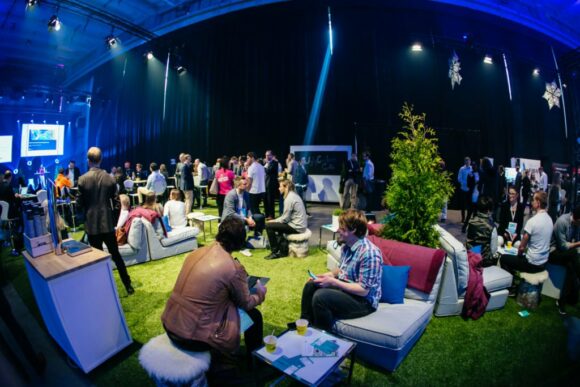
Depending on the time of day and the size of its area, the cafeteria can offer the moment of relaxation that workers need both for their creative professional fulfillment and their personal development.
Today, the equation between fulfillment and productivity no longer needs to be proven. Many business leaders have understood this, as evidenced by the proliferation of relaxation spaces in the office environment.
Hyper-concentration does not “always” lead to success: on the contrary, it has been proven that it distances workers from the inspiration necessary for quality work—regardless of the sector concerned.
Far from contradicting this philosophy of well-being, the cafeteria stands as the essential living space of a company: if it is a means of promoting interaction, it is also a means of “taking a break” and disconnecting from the laborious feeling of having a task to complete.
Thus, the cafeteria is an opportunity to have a “recreational” breathing moment useful for work. Whether alone or with a colleague, one encounters a universe where disconnection becomes possible. As beneficial as it is pleasant…
Several factors explain this:
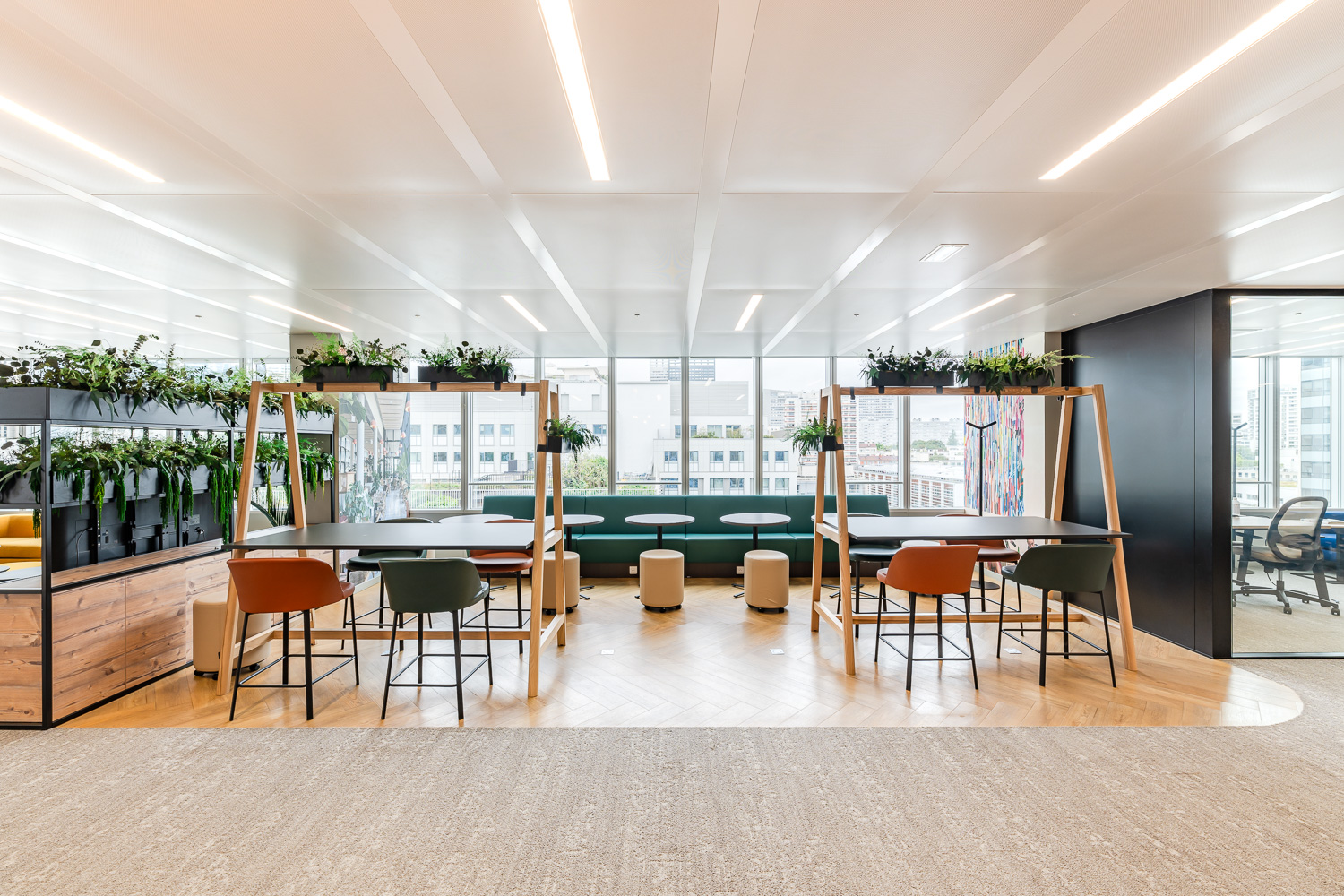
Very often, the presence of plants as well as comfortable and aesthetic furniture help create an atmosphere conducive to relaxation.
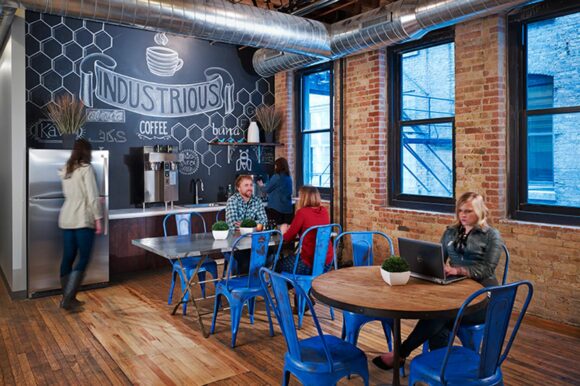
Beyond its essential purpose of dining and comfort, the cafeteria also allows mixing relaxation with work, due to the integration of furniture ensuring the execution of basic professional tasks such as “conference calls” or online research.
The use of “work pods” helps define a framework that is both intimate and open where it is possible to concentrate while being connected to a constantly evolving space.
The presence of high tables or banquettes, often located in recessed areas, constitute furniture illustrating this evolution, while allowing for real professional activity, particularly when these zones are integrated into a generously proportioned cafeteria space that allows for diversity.
In addition to furniture promoting individual work, we can also mention the importance of “elements” promoting collaborative work, such as HD screens that allow temporarily converting the cafeteria space into a meeting room.
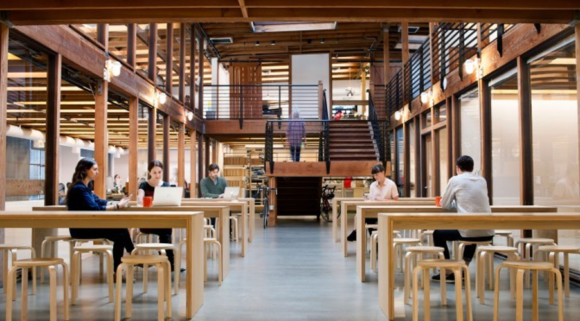
This set of intentional and planned functions, through an elaborate and modern architectural design, fully justifies the presence of a cafeteria within the professional environment.
Moreover, it demonstrates the plurality of possibilities of an architectural space as an evolving living space, far removed from the homogeneous and standardized bureaucratic universe from which the office is barely emerging.

Director CLUE ME
Director CLUE ME